Describe the behaviour
What are the doors doing?
An operator fault can interrupt lift service, but a door that will not close does not automatically need a new operator. We assess the complete movement and the signals controlling it.
Doors will not open or close
The investigation can include the operator’s supply, commands from the lift controller, motor and drive, and whether the mechanism can complete its travel.
Slow, jerky or incomplete movement
Mechanical resistance, worn transmission parts or a motor-control problem may affect movement. We check the equipment and its feedback, where fitted, before recommending work.
Doors close, then reopen
A reopening request can come from a safety edge or detector. Resistance in the doors or another control condition can also interrupt closing; the operator may be responding to a problem elsewhere.
New noise or uneven panel travel
Belts, pulleys, linkages and rollers or guides may need attention. Tell us about sounds or changes already noticed during normal use.
Does it happen everywhere, or at one floor?
On many automatic lifts, the car-mounted operator serves every landing. A problem confined to one floor can therefore point towards that landing’s doors or their engagement with the car doors. This is useful information for an engineer, rather than a diagnosis on its own.
If the doors are behaving dangerously
Stop using the lift and report the problem to the building team and maintenance provider. Do not force the doors or try adjustments. For an urgent breakdown, call 020 7097 8588. If you are trapped, use the alarm to call for help and remain inside.
The operator moves the doors. Other components matter too.
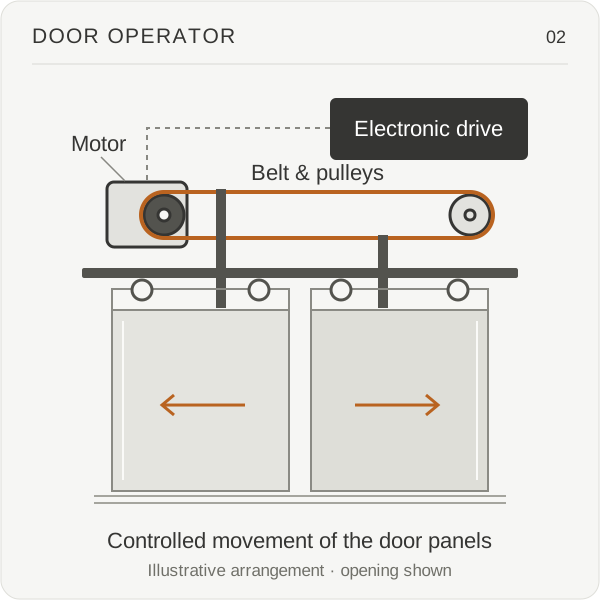
The operator combines a motor, a transmission such as a belt or linkage, and the equipment that controls its movement. On many lifts, a coupling mechanism connects the car doors to the landing doors when the car is at a floor.
- Drive and motor
- The electronic drive controls the motor’s movement. Some systems use an encoder to report motion; others use different arrangements. Motor and control equipment must suit each other.
- Transmission and door mechanism
- Belts, pulleys or linkages transfer movement to the panels. Tracks, hangers, rollers and guides influence how freely the doors travel. A new drive will not remove mechanical damage elsewhere.
- Detection and locking
- Detector edges monitor the entrance for obstructions. Locks and interlocks perform a separate safety function. A door reaching its closed position does not, by itself, prove the locking conditions are satisfied.
For a fuller explanation of the mechanism, read how lift door operators work.
Repair the cause
A worn component, a failed drive or a complete operator?
We compare the condition of the existing system, the fault found and the availability of suitable parts. The recommendation should explain what needs changing and what can remain in service.
Repair or replace an individual component
A serviceable operator may need a suitable belt, cable, pulley or other identified part, together with the necessary adjustment and checks. Door rollers and spares may be part of the work where the fault is mechanical.
Assess the motor or electronic drive
A failed motor, drive or feedback component may be replaceable separately where compatible parts are available. Forge also carries out in-house electronic repairs to control boards and drives, assessed case by case. We can discuss whether a door drive is a suitable candidate.
Replace or upgrade the operator
Extensive wear, obsolete equipment or limited spares may make replacement more practical. We assess how the proposed operator will work with the existing doors and controls, including any associated changes needed.
Support across a wide range of brands
Examples of door equipment and controls we can assess include Fermator, Wittur/Selcom, Sematic and Siemens SIDOOR. We also assess other makes and legacy systems. Send us the details of what is fitted; we confirm suitable parts and installation options for your lift.
An operator upgrade does not necessarily mean replacing every door or the whole lift. Where the entrances need more extensive work, we can consider it as part of a planned lift modernisation.
Replacement includes the installation and setup.
We supply and install suitable equipment. An operator needs to fit mechanically and communicate correctly with the lift; matching a manufacturer’s name alone is not enough.
- Door arrangement: opening type, travel, panel load, available space and mounting.
- Mechanical compatibility: the transmission, coupling and condition of the car and landing doors.
- Control compatibility: supply, motor and feedback arrangement, movement commands and status signals.
- Commissioning: the applicable setup, movement checks and operation of associated detection and locking equipment.
We agree the work and access arrangements before installation. Following completion, your job sheet records the work, lift status and any follow-up. Planned maintenance provides ongoing attention to the door equipment under the agreed service scope.
What affects the cost and time out of service?
A component repair and a complete operator conversion are different jobs. The quotation depends on:
- Whether the fault is established or further investigation is needed.
- The parts required and their availability, including any matched motor or drive.
- Changes to brackets, coupling, wiring or the wider door mechanism.
- The number of entrances, site access and the commissioning work.
We confirm the proposed scope, lead times and expected interruption once the equipment has been assessed. Tell us if the lift is the building’s only accessible route or if work must fit around opening hours. For more on quotations, see what affects lift repair costs.
Door operator questions.
Do reopening doors mean the operator has failed?
No. The operator may be responding to an obstruction signal, mechanical resistance or another control condition. We investigate the cause before proposing a replacement.
Can you repair the operator instead of replacing it?
That depends on the fault, condition and available parts. A belt or another individual component may be replaceable. Electronic repair is assessed case by case. We explain when a repair is practical and when an upgrade deserves consideration.
Can you replace an obsolete door operator?
We can assess the options for older equipment, including a suitable replacement or conversion. We need to check the door arrangement, controls and mechanical interfaces before confirming what can be retained.
Will new door panels or landing doors be needed too?
Not automatically. Existing doors may be retained if their condition and compatibility allow. If the survey identifies worn or unsuitable associated equipment, the quotation sets out that additional work.
Do we need a maintenance contract with Forge?
No. One-off fault finding, repairs and replacement enquiries are welcome across London and the South East. Share the site postcode, what is happening and any existing reports.
Should we reset the lift when the doors stop working?
Report what has happened rather than repeatedly resetting the lift or operating equipment controls. A temporary recovery does not establish that the fault has been repaired. Follow the maintenance provider’s instructions for your installation.
Fault finding · Repairs · Replacement
Tell us about the door problem.
You do not need to select a replacement operator before contacting us. Useful details include:
- The site postcode and lift location.
- What the doors do, and whether it affects one landing or several.
- The operator make and model from existing reports or equipment records.
- Recent work, fault history and access requirements.
Send records or photographs you already have. You do not need to remove panels or access the car roof or shaft to make an enquiry.
The form carries the door-operator category across for you to check or change. The email link opens your email app, where you can attach files.
Related support
Keep the whole door system in view.
- Lift door fault finding and repairs — support when the cause is not yet clear.
- Safety and detector edge repairs — assessment of entrance detection equipment.
- Recurring lift breakdowns — keeping a useful history when a fault returns.
Technical background.
Manufacturer examples show why the mechanism, drive and lift controls need to be considered together. They describe particular systems, not a universal specification.
- Siemens SIDOOR system manual (PDF) — controller, motor and belt-drive arrangement.
- Wittur/Sematic SDS drive manual (PDF) — examples of mechanical strain, signal and motor-feedback faults.